

An LPN (License Plate Number) label is the workhorse of modern warehouse tracking: one scannable barcode that represents an entire pallet, tote, or carton of inventory inside a warehouse management system (WMS). This guide explains what LPN labels are, how they move through a facility, which formats and materials to choose, and why preprinted labels with verified sequential numbering outperform in-house printing at scale.
What is an LPN label?
An LPN (License Plate Number) label is a unique barcode identifier applied to a pallet, carton, tote, or container to track that specific logistics unit and its contents within a warehouse management system (WMS). Much like a vehicle's license plate ties a registration number to a vehicle owner and history, an LPN barcode links a physical container to a dynamic record in your database. Scanning an LPN instantly retrieves all associated inventory data without requiring workers to count or scan individual items inside.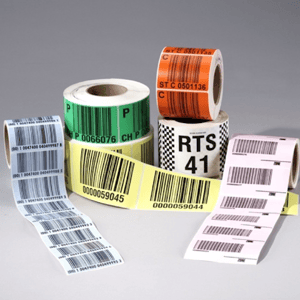
In supply chain and warehouse management, buyers and system administrators refer to LPN labels by several common terms:
- License plate number labels
- LPN barcode labels
- Pallet ID labels
- Serialized or sequential labels
- Warehouse tracking labels
Having a strong labeling system is beneficial on many levels and LPNs serve as the core building block for automated tracking. To evaluate options for your facility, explore our Pallet/LPN Labels product page.
How an LPN moves through a warehouse
An LPN barcode tracks an inventory unit through six operational stages:
- Receiving - Workers attach an LPN label to inbound goods on a pallet or tote, scanning it once to register the shipment into the WMS.
- Putaway - Drivers scan the LPN label, and the WMS returns exact bay and rack storage directions.
- Storage - The WMS monitors the LPN label's dynamic location during cycle counts and stock shifts without manual line audits.
- Picking - Pickers scan the LPN label to verify correct batch allocation and enforce FIFO (first-in, first-out) rules.
- Staging - Picked containers are scanned into staging lanes to consolidate order shipments.
- Shipping - A final scan at the dock door reconciles the pallet against the bill of lading prior to truck loading.
The central database record tied to an LPN barcode typically contains:
- SKU numbers and item descriptions
- Unit counts and batch/lot numbers
- Manufacture and expiration dates
- Supplier data and country of origin
- Weight, dimensions, and spatial requirements
- Outbound destination routing codes
Using LPN tracking generates substantial labor savings. One scan at receiving replaces scanning every item in the container, updating dozens or even hundreds of unit records simultaneously. According to operational metrics from the Warehousing Education and Research Council (WERC), high-performing distribution centers rely on single-scan container processing to compress receiving cycle times and improve inventory accuracy. LPN tracking is a proven method for optimizing warehouse operations.
For 3PL (third-party logistics) operators, LPN barcode tracking is essential for multi-tenant management. It allows distinct client inventories to sit side-by-side on shared racking while maintaining complete data separation in software. Integrating preprinted LPNs helps address broader labor constraints, while proper barcode integration optimizes daily throughput (see 3 Ways a WMS with Proper Labeling Improves Operations).
Formats, Materials and Adhesives
ID Label produces LPN labels in dedicated sizes and configurations engineered for specific material handling workflows:
| Format | Common Application |
|---|---|
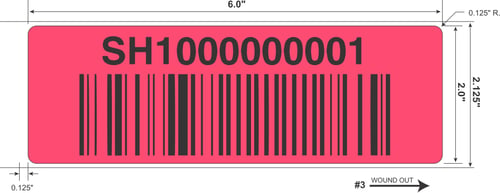
| 4" x 2" LPN | Industry standard for general pallet identification, rack containers, and tote tracking |
| 4" x 2" LPN with custom branding | Company logos, custom color bars, or human-readable text for clear owner identification |
| 4" x 2" Outbound LPN | Short-term external tracking during outbound distribution |
| 4" x 3" Writeable transfer | Surface optimized for manual pen entries or thermal transfer additions |
| 3" x 2" Carton label | Smaller master cartons, totes, and compact shelf bins |
| 4" x 6" Label | Compliance shipping placards and complex multi-barcode layouts |
| 3" x 5" with 2D barcode | 2D Data Matrix or QR codes combined with 1D symbologies for dense data storage |
| 2" x 8" / 2" x 10" Wraparounds | Wraps around pallet corners to enable dual-sided scanning |
| 2" x 4" with custom branding | Compact branded option for specialized container designs |
Wraparound formats solve a key efficiency bottleneck for lift truck drivers. Applying a 2" x 8" or 2" x 10" label across a pallet corner allows drivers to scan the barcode from two adjacent sides without exiting the truck cab.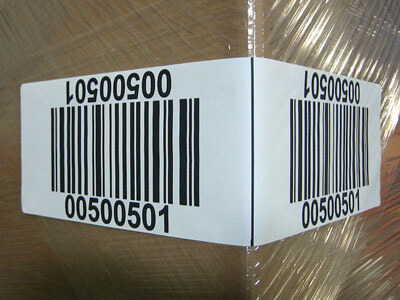
| Component | Option | Primary Application |
|---|---|---|
| Face Sheet Materials | Coated Paper | Standard indoor warehousing and fast-moving inventory |
| Face Sheet Materials | Polyester | High-durability environments requiring moisture, chemical, and abrasion resistance |
| Adhesive Types | Permanent | Long-term rack, tote, and pallet adhesion |
| Adhesive Types | Freezer-Grade | Sub-zero cold storage application and deep-freeze warehousing |
| Adhesive Types | Removable | Short-term tracking on reusable plastic containers (RPCs) |
Selecting the proper specifications prevents scan failures in demanding environments: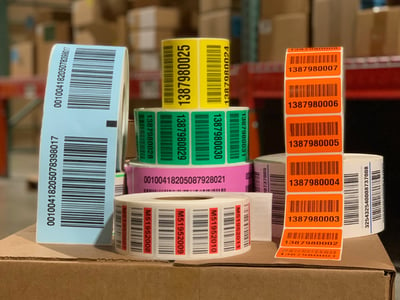
- Cold Storage Performance - Standard adhesives fail in sub-zero conditions. Specialized Arctic Xtreme labels can be applied in ambient temperatures as low as -20°F and maintain structural service from -65°F to +300°F.
- Retroreflective Solutions - Retroreflective face sheets enable long-range scanners to read pallet LPN barcodes from up to 60 feet away on high rack tiers.
There are several cold storage labeling challenges and factors to consider that are not typically found in the ambient areas of a warehouse, due to the harsh conditions and temperatures. Additionally, maintaining visible identification alongside facility standards — such as aisle clearance under OSHA 1910.176 — keeps material handling pathways safe and efficient.
Lastly, while 1D Code 128 barcodes remain standard, 2D barcodes (Data Matrix or QR codes) are selected when high data density must fit into compact formats like a 3" x 5" footprint.
Sequential Numbering: How to Prevent Duplicates
Duplicate LPN numbers across reorders cause serious reconciliation errors in a WMS. If two pallets enter the system with identical numbers, the software overwrites existing data records, leading to misplaced inventory, incorrect picks, and costly reconciliation downtime.
ID Label prevents this by managing sequential ranges through an automated database that logs every starting and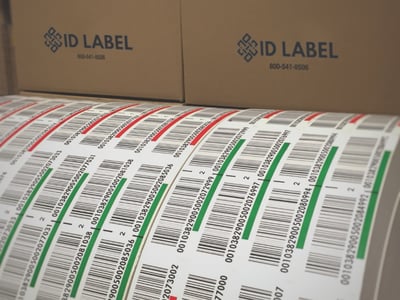 ending number across every customer order. The automated sequence log covers every serial number produced by account, ensuring future orders continue sequentially without overlap.
To streamline high-volume inventory operations, our Make-and-Hold Pallet Label Program pre-prints large volumes of sequential LPN labels, stores them in warehouse inventory, and ships rolls on demand while ensuring sequence integrity across reorders.
Every roll of preprinted LPN labels undergoes a strict 20-step quality check that verifies scannability, print density, and sequence accuracy. Why? Because unreadable or duplicate barcodes can quickly increase warehouse costs. See the impact bad scans can have on your bottom line by using our interactive Miss-Scan Calculator.
Preprinted LPN Labels vs In-House Printing
In-house print-on-demand setups offer real flexibility for minor, unpredictable labeling needs. With in-house printing, labels are available on the spot, and short runs don't require a vendor order or lead time.
Preprinted LPN labels deliver verified quality and lower total cost at volume. Every roll arrives digitally printed, inspected, and sequence-verified with none of the maintenance overhead that in-house printing introduces.
At high volumes, printing LPN barcodes in-house carries hidden operational costs. Thermal printheads degrade over time, leading to dead print zones, scannability drops, ribbon jams, and human error in setting starting numbers, which increases the risk of duplicate sequences.
Significantly, blank thermal labels made for on-demand printing — including ID Label's own blank labels — lack a protective clear laminate coating, leaving printed barcodes susceptible to smudging, scraping, chemical contact, and UV exposure on the warehouse floor.
Preprinted LPN labels eliminate desktop printer maintenance, reduce per-unit costs at scale, and deliver verified scannability. Two more key considerations: how to produce your LPN labels in a way that's cost effective and most efficient for warehouse workers, as well as ensuring quality consistency along with cost savings.
Frequently Asked Questions
What does LPN stand for?
LPN stands for License Plate Number. In logistics and warehouse operations, it refers to an alphanumeric barcode string assigned to a pallet, tote, or container to track all contained inventory within a warehouse management system.
Is an LPN the same as an SSCC (Serial Shipping Container Code)?
No. An LPN is typically an internal barcode format used to track inventory within a company's owned facilities or WMS network. An SSCC is an 18-digit global shipping identifier managed under GS1 General Specifications used for external EDI transactions, cross-docking, and international supply chain movement between trading partners.
Can LPN labels be used in a freezer?
Yes. LPN labels can be used in cold storage and freezers when constructed with specialized cold-temperature adhesives or heavy-duty magnetic backings. Formulations like Arctic Xtreme™ labels can be applied at temperatures as low as -20°F and maintain adhesion in service down to -65°F.
How do you stop duplicate LPN numbers across reorders?
Source labels from a manufacturer that uses an automated sequence management tracking system. The system logs every serial number produced by account, ensuring future orders continue sequentially without overlap.
What size is a standard LPN label?
The most common standard LPN label size is 4" x 2" for pallets, totes, and rack containers, and 4" x 6" for compliance shipping placards. Custom sizes range from 2" x 4" to 2" x 10" wraparound formats based on application needs.
Optimizing your inventory control starts with clean, reliable serial tracking on every pallet and container. ID Label manufactures preprinted LPN barcode solutions engineered for 100% scan accuracy, extreme temperature resistance, and verified sequence management across every reorder. Explore custom materials, sizes, and program options on our Pallet/LPN Labels product page to request samples or get a quote for your facility.