

Warehouse labeling is the systematic use of scannable labels to identify every location, rack, pallet, bin, floor zone, and asset within a facility. This guide is designed to be a comprehensive resource for facility managers, operations leaders, and warehouse supervisors who are planning a new facility, executing a relabeling project, or looking to improve an existing labeling system. From label and material types to implementation and best practices, we will cover how to approach your warehouse labeling projects.
Having a strong labeling system is extremely important and beneficial on many levels. Research suggests that a typical warehouse may face an annual inventory error value of $195,000. This can be avoided by implementing a high-quality labeling system, significantly boosting picking accuracy, scan rates, and overall productivity while reducing errors.
What Is Warehouse Labeling?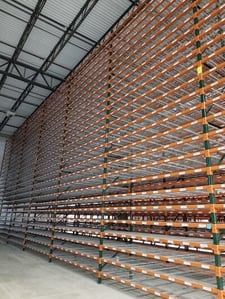
Warehouse labeling is the structured process of applying labels, such as barcodes, QR codes, or RFID tags, to physical locations and inventory. These labels allow users and automated systems to quickly and efficiently identify racks, bins, shelves, pallets, and individual products. In an environment where every second counts, these labels serve as the bridge between physical operations and your Warehouse Management System (WMS), ensuring optimal performance.
An effective labeling system makes items easily scannable and logically organized. This reduces error and facilitates real-time updates during the receiving, picking, packing, and shipping processes. Beyond simple identification, these labels support inventory visibility and operational automation.
Why Warehouse Labeling Matters
Effective warehouse labeling drives measurable cost savings and improvements across five critical areas of operation:
- Picking Accuracy: Mislabeled or missing locations are one of the leading causes of picking errors. Clear, scannable labels reduce the opportunity for worker error and give the WMS accurate confirmation of each
 transaction.
 - Operational Efficiency: Workers spend less time searching for locations when labels are legible, consistently placed, and logically sequenced. Faster navigation means more picks per hour.
- Inventory Accuracy: Accurate location labels support reliable cycle counting and physical inventory. When every location is clearly identified, miss scans are easier to find and resolve.
- Safety and Compliance: OSHA guidelines for warehousing include requirements for aisle marking, hazard identification, and emergency protocols. Proper signage and floor labels are part of meeting those standards.
- WMS Performance: A WMS depends on clean, consistent location data. Labeling that follows a logical naming convention and barcode format compatible with the WMS ensures transactions are captured correctly from day one.
When correctly addressing these areas with a labeling solution, your operation and workers can be more productive while minimizing chances for errors and downtime.
Types of Warehouse Labels
What types of labels are used in a warehouse? A variety of specialized labels are required to navigate the different locations of a facility, including rack and beam labels, floor labels, and specialized signage. For a detailed breakdown, visit ID Label's guide to common types of warehouse labels.
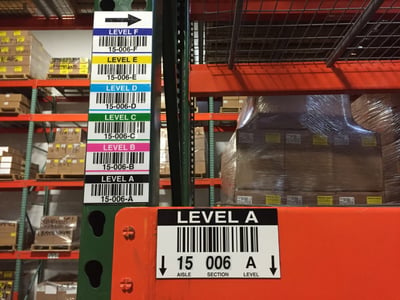
- Rack and Beam Location Labels: Made of polyester or retroreflective materials for durability and long-range scanning.
- Pallet and LPN Labels: Used to track products and materials from the moment they enter the warehouse until they leave.
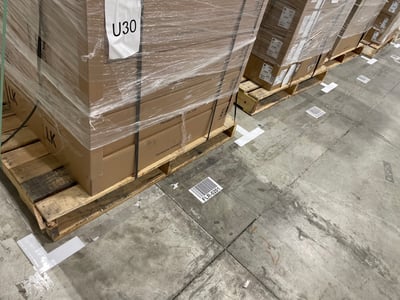
- Warehouse Floor Labels: Extremely durable solutions designed to withstand heavy forklift traffic and foot movement.
- Shelf and Bin Labels: Ideal for smaller items or broken-case inventory to ensure quick identification.
- Aisle Signs and Warehouse Signage: Used for high-level navigation, often made from PVC or retroreflective materials for overhead visibility.
- Magnetic Warehouse Labels: A flexible choice for operations where configurations change frequently, as they are easy to move and reposition.
- Repositionable Labels: Ideal for 3PLs or seasonal operations that require frequent relabeling without leaving a sticky mess behind.
- Custom Warehouse Labels: Tailored solutions designed for specific environmental challenges or unique numbering schemes.
Barcode vs. QR Code vs. RFID Labels
| Technology | Data Capacity | Scanner Required | Primary Use Cases |
|---|---|---|---|
| 1D Barcode Labels | Limited (Alphanumeric) | Standard Laser/Imager | Rack locations, general inventory |
| 2D Barcode (QR Code) Labels | High (URLs, detailed data) | 2D Imager/Smartphone | Product packaging, detailed asset info |
| RFID Labels | Very High | RFID Reader | High-value assets, bulk scanning without line-of-sight |
Where to Use Warehouse Labels
For a warehouse to function seamlessly, labeling must be applied consistently across all functional areas.
| Location | Purpose | Recommended Label Type |
|---|---|---|
| Warehouse Racking | Primary storage identification | Multilevel or beam labels |
| Warehouse Shelves | Narrowing down picks within a rack | Adhesive or magnetic shelf labels |
| Pallets/LPN | Tracking bulk movements | License Plate Number (LPN) stickers |
| Floor: Bulk Zones | Identifying open storage areas | Durable floor labels or frames |
| Floor: Staging | Managing inbound/outbound flow | Heavy-duty floor signage |
| Totes and Containers | Tracking grouped items | Removable or permanent bin labels |
| Aisle Signs | Long-distance navigation | Overhead retroreflective signs |
| Dock Doors | Directing shipping and receiving | Large PVC or metal dock signs |
| Outdoor Areas | Weatherproof navigation | UV-resistant or metal labels |
Choosing the Right Label Materials
Warehouse labels are made from a range of substrates and adhesive materials, each selected based on the environmental conditions of the application to ensure the labels don't fail.
| Label Material | Key Characteristics | Best Use Case |
|---|---|---|
| Polyester | Extreme durability, chemical resistance | Long-term rack labeling |
| Polypropylene | Flexible and cost-effective | Bin and tote labeling |
| Retroreflective | Contains micro-prisms to return light | Long-range scanning (up to 45 ft) |
| Aluminum | Maximum lifespan, heat resistance | Outdoor signage or heavy industrial use |
| Freezer-Grade | Specialized adhesive for subzero temps | Cold storage and freezer environments |
| UV-Resistant | Resists fading and sun damage | Outdoor docks and staging areas |
When choosing materials, also consider adhesive options. Permanent adhesives are standard for fixed locations,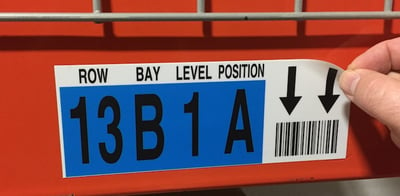 while repositionable adhesives like ID Label's Clean Release™ are preferred for operations that shift inventory or zone designations frequently. Repositionable adhesives are also beneficial for clean removals. If your labels are failing more often than expected, the adhesive is most likely not compatible with the current surface or environment. Refer to ID Label's why warehouse labels fall off blog for solutions to avoid this problem.
Color coding is another effective strategy, helping teams visually distinguish zones or product priorities at a glance. Color-coded labeling can seamlessly integrate with current WMS configurations. Refer to our blog for more key warehouse label performance factors.
Best Practices for Warehouse Labeling
A successful warehouse labeling project begins with thorough planning and a commitment to consistency across the entire facility.
- Establish a Naming Convention: Define your location naming structure, aisle designations, rack numbering, and level coding before labels are printed. See ID Label's tips for effective warehouse numbering schemes for a practical starting point.
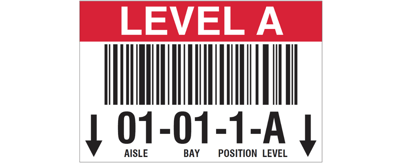
- Match Material to Environment: Select the appropriate substrate and adhesive based on where the label will be used (i.e., freezer environments, outdoor exposure, chemical contact, etc.).
- Standardized Placement: Apply labels at the same height and position on every rack bay, regardless of manufacturer or configuration. ID Label's warehouse label standardization guide provides a framework for building consistent placement rules.
- Prioritize Visibility: Use high-contrast colors and large fonts to ensure labels can easily be read.
- Verify WMS Compatibility: Confirm that your chosen label barcode format is fully supported by your hardware and software systems to ensure improved operation.
- Test Scan Accuracy Early: Conduct a test in one zone to ensure labels scan correctly from the required distances and angles.
- Implement Proactive Label Maintenance: Set a schedule to inspect and replace damaged or faded labels before they cause operational delays.
Choosing the Right Warehouse Labeling System
Implementing a labeling system is a high-ROI investment, but it requires careful consideration of several factors.
Planning Your Labeling System
Start with a facility audit. Walk through the operation and document every area that requires labeling: rack bays, floor zones, aisle signs, dock doors, and any specialized storage areas. Map your naming convention to the physical layout before engaging a label vendor. The planning phase is also a great time to align with your WMS team on location codes, barcode formats, and label data requirements. For a step-by-step roadmap, see ID Label's guide to a successful warehouse label and sign installation project.
Custom vs. Standard Labels
Standard label formats work well for many applications, but facilities with unusual rack configurations, specialized environments, or specific WMS requirements often benefit from custom-engineered labels. Custom labels can be sized to fit non-standard rack uprights, printed with facility-specific color codes, or manufactured from materials not available in off-the-shelf products. The tradeoff is lead time and minimum order quantities, so plan accordingly.
Installation (DIY vs. Professional)
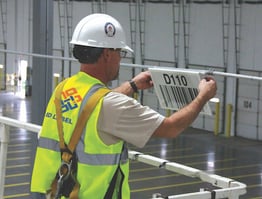 Smaller facilities with straightforward rack configurations may be able to handle label installation internally. Relabeling projects for larger facilities involve thousands of locations or installations that must run simultaneously with live operations and are better suited for professional installation crews. Professional installers bring the equipment, crew, and experience to complete a project on schedule with minimal disruption. For facilities managing an active relabeling project, ID Label's guide on how to survive warehouse relabeling provides the steps for a smooth transition.
Ongoing Maintenance
Labels degrade over time. Forklift impacts, cleaning chemicals, UV exposure, and frequent use all reduce label life. Build replacement labels into your annual budget and establish a process for reporting and replacing damaged labels quickly and quarterly. A proactive maintenance approach prevents unsuspecting scan failures that would affect inventory accuracy.
Labeling Solutions and Technologies
Modern labeling involves more than just stickers; it integrates advanced printing and scanning technologies. Thermal transfer printing is the standard for warehouse labels, producing durable, fade-resistant images without ink. Direct thermal printing is appropriate for shorter-lived labels like preprinted pallet/LPN labels.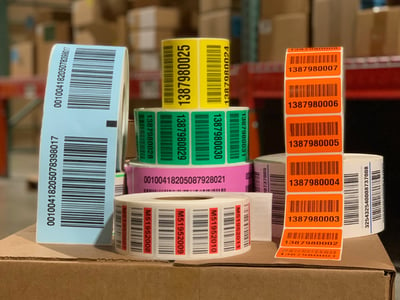
On-demand label printers installed at receiving docks or packing stations allow facilities to print labels on site, reducing label pre-printing and staging requirements. Handheld scanners, wearable ring scanners, vehicle-mounted terminals, and fixed-position scan tunnels each serve different use cases. The right scanner depends on the label format, the distance between the scanner and the label, and the ergonomics of the picking or receiving workflow.
Integrating these tools with your WMS creates a digital ecosystem that automates inventory tracking and minimizes manual labor. This integration ensures that every scan updates the current information in real time. For more on the relationship between labeling and WMS performance, see 3 ways WMS with proper labeling improves operations.
Benefits of Warehouse Labeling: Real World Success
The impact of a professional labeling strategy is best seen through real-world results. For example, FST Logistics improved picking accuracy by implementing a color-coded beam label system, which simplified navigation for their warehouse team. This solution was implemented across facilities soon after, reducing the time required for monthly inventory cycle counts.
Lowe's undertook a large-scale relabeling initiative across 15 distribution centers in partnership with ID Label. The project required coordinating label design, production, and installation across a network of facilities without disrupting ongoing distribution operations. The result was a standardized labeling system across all 15 locations, improving scan consistency and inventory accuracy network-wide. Read the full Lowe's relabeling case study.
Frequently Asked Questions
How often should warehouse labels be replaced?
High-quality labels typically last one to three years, but they should be replaced immediately if they become damaged, faded, or unreadable. Quarterly audits are recommended to maintain data integrity.
What are common mistakes in warehouse labeling?
Frequent errors include using inconsistent naming conventions, choosing low-quality materials that peel, choosing the incorrect label for your environment, and failing to test scanning distances before full rollout.
What barcode format is standard for warehouse labels?
While Code 128 and GS1-128 are highly common in logistics, the "standard" depends on your specific WMS requirements and data needs.
Can I install warehouse labels myself?
Yes, you can install warehouse labels yourself, but professional installation is often more cost-effective for large facilities as it avoids common errors like crooked placement or poor surface preparation that can lead to label failure.
Warehouse labeling is more than an operation detail; it is critical infrastructure that enables speed, accuracy, and growth. By choosing the right materials and following best practices, you can optimize and make your operation more efficient. Whether you are starting a new warehouse project or refining a current one, a strategic labeling approach will set you up for long-term success. Contact us for your warehouse labeling needs here!