

In the race to maximize throughput and combat labor shortages, modern fulfillment centers are investing heavily in warehouse automation. A 2025 survey from Peerless revealed 48% of polled companies said they are already using one or more robots within their organizations. Operations leaders and 3PL executives spend months calculating the ROI of these deployments, deeply analyzing fleet software integrations, battery cycle times, and pick-per-hour metrics. Yet, amidst the excitement of deploying millions of dollars in advanced technology, one critical element is frequently overlooked: the physical labels and tags that warehouse robots depend on to interact with the real world.
Warehouse robots primarily use a combination of April tags (fiducial markers) for spatial navigation and barcode tote labels for inventory identification.
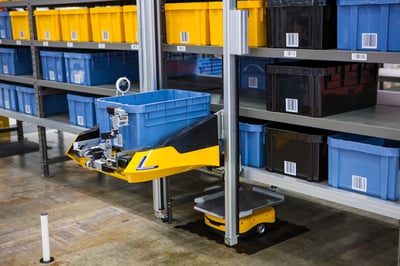 When deploying a new warehouse automation solution, operations leaders often focus heavily on software integrations and fleet throughput specs. However, the physical labels and infrastructure that warehouse robotics depend on is a critical success factor that can make or break the investment. Without a reliable physical-to-digital link, even the most advanced automated fleet cannot function.
At the center of modern robotic operations is a clear division of labor between two distinct types of warehouse labels:
- April tags act as the system's navigation coordinates, placed on racks and floors to tell robots where to go.
- Tote barcode labels act as the inventory identifiers, telling robots exactly what to retrieve.
In this article, we will cover the specific common types of warehouse labels that automated systems rely on every day, what operational changes occur when a facility introduces robotics, and how ID Label supports smooth automation deployments with engineered, high-performance labeling solutions.
How Warehouse Robots Use Labels to Navigate and Pick
Implementing a robotic picking system shifts the burden of data collection away from manual RF scanners and completely onto automated vision systems. Because computers process visual data differently than humans, successful automated operations rely on a tightly coordinated two-label system to keep workflows moving without a hitch. One type of label manages facility-wide movement, while the other handles inventory accuracy.
April Tags for Robot Navigation
To safely navigate tight warehouse aisles, autonomous mobile robots (AMRs) require precise, real-time spatial orientation. This coordinate tracking is achieved through specialized fiducial markers known as April tags.
An April tag is a type of high-contrast, two-dimensional fiducial marker that resembles a simplified square QR 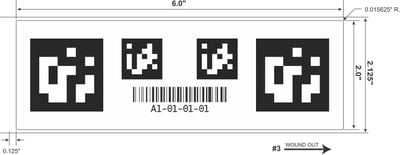
code and allows automated camera systems to calculate its exact 3D position, distance, and angle relative to the robot. In warehousing, April tags are affixed directly to rack faces and flooring to serve as precise visual reference points for navigation. By continuously scanning these physical markers, an AMR can calculate its exact position within a facility down to the millimeter.
ID Label supports these advanced navigation systems by manufacturing the high-performance rack labels and durable floor markers required to display them. We ensure that these critical codes are printed with the ultra-sharp, high-contrast resolution that machine-vision cameras require, using rugged materials engineered to resist scratching, fading under bright industrial lighting, and daily wear. Our April tag labels are also produced with a matte overlaminate to reduce glare-related obstruction and improve readability.
Tote Barcodes for Inventory Identification
While an April tag tells an automated system where to go, a tote barcode label tells the machine exactly what to retrieve. It represents the physical-to-digital transition between an individual container and your warehouse management system (WMS).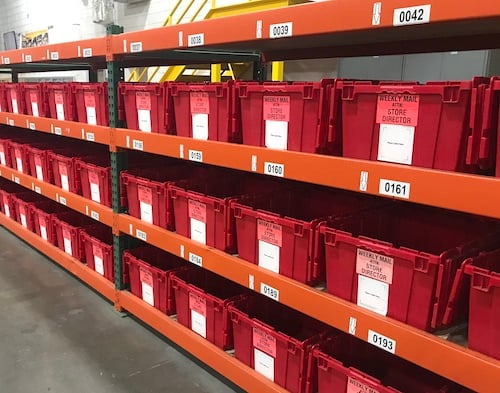
In a robotic picking system, tote barcodes work by linking a unique, randomized asset identifier on a reusable container directly to live inventory data within the WMS. When an automated picker reaches a specific location and scans the tote label, it instantly validates that it is interacting with the correct batch, eliminating picking errors before an item is even pulled.
To keep robotic picking systems running at peak throughput, your tote labels and pallet / LPN labels must adhere to strict engineering standards:
- Barcode Format & Compatibility: Depending on your WMS and robotic scanner configuration, you may need traditional linear 1D barcodes or high-density 2D data matrix codes. ID Label prints these with ultra-sharp, high-contrast definition to allow rapid, multi-angle scanning by automated vision systems.
- High-Cycle Material Durability: Automated totes endure constant mechanical friction, conveyor belt travel, and robotic gripping. Cheap paper labels will quickly smudge, tear, or peel, causing immediate system faults. ID Label manufactures labels using rugged, scratch-resistant materials designed to survive thousands of cycles.
- Consistent Geometric Placement: Robots do not have human flexibility. If a tote label is applied crookedly, or placed an inch too high, fixed-mount cameras may miss it entirely. ID Label's team of installation experts can partner with you to ensure every barcode is delivered with exact, repeatable positioning across your entire fleet.
In dynamic automation environments, inventory assignments change frequently. Instead of wasting time scraping off old adhesive or layering labels, use ID Label's Tote Renew™. It features a specialized top layer that allows you to easily apply, scan, and cleanly peel off sequential pallet / LPN labels or tracking barcodes thousands of times over the life of the tote.
Floor Labels and Navigation Zones in Robotic Warehouses
While rack-mounted markers guide vertical picking, specialized floor labels are essential for defining a robot's 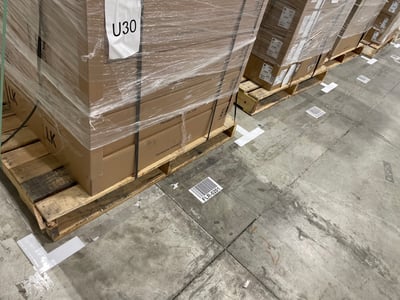 horizontal operating landscape. These markers visually partition the warehouse floor into distinct functional areas, mapping out automated travel lanes, high-density pick zones, robotic charging stations, and restricted, human-only safety corridors. Because autonomous fleets move with computerized precision, they follow exact, pre-programmed digital tracks. This means their heavy drive units pass over the exact same physical floor coordinates thousands of times a day, creating concentrated, highly destructive friction that quickly obliterates standard tape or low-grade stickers.
To prevent these navigation tracks from wearing away and triggering systemic fleet navigation faults, facilities require industrial-grade warehouse floor labeling solutions. ID Label's Floor Shield labels and heavy-duty protective covers are engineered specifically for these high-traffic automation zones. Designed to withstand the relentless pivoting, scrubbing, and rolling weight of robotic tires, these ultra-durable kits keep your facility's grid layout perfectly legible to machine vision systems, ensuring continuous uptime without the need for constant maintenance shutdowns.
Rack Labels in a Robotic Operation
In a traditional manual warehouse, a damaged or faded rack label is an inconvenience; a worker can usually tilt their wrist, step closer, or manually key in the location code. In a robot-assisted facility, that same damaged label is an operational roadblock. Because automated picking systems lack human flexibility, a single misread or obscured rack label can instantly halt a pick cycle, which triggers an error code, flags an exception, and requires manual human intervention that ruins system throughput.
To maintain a continuous workflow, rack labels in an automated environment must be engineered around the strict parameters of machine vision:
- Fixed-Position Scan Accuracy: Unlike humans who can dynamically adjust their scanning angle, robotic scanners are often fixed at rigid, predetermined angles. This means rack labels must feature immaculate print definition and a specialized matte, non-glare finish to prevent overhead industrial lighting from blinding the robot's cameras.
- Flawless Placement Consistency: Automated systems rely on absolute uniformity. If a label is applied even a fraction of an inch out of alignment from one bay to the next, it may fall entirely outside the robot's field of view.
- Durability: Racking faces are prone to minor scrapes from nearby machinery or passing inventory. The label substrate must be rugged enough to resist tearing or peeling under everyday warehouse conditions.
To simplify deployment, many modern automated facilities are now opting for a combined layout. These integrated designs display both the standard alphanumeric location barcode and the localized April tag navigation marker on a single, cohesive faceplate. While the unique April tag data stream is sourced directly from your robotics vendor, ID Label provides the high-performance, precision-manufactured engineered rack labels substrate. This ensures a perfectly flat, highly durable surface that keeps both your navigation markers and inventory data running flawlessly side-by-side.
Relabeling When Introducing Robotics
When introducing robotics, a warehouse typically needs to replace its legacy rack labels to meet strict machine-scanning tolerances, update its location numbering schemes to match the new automated tracking software, and install specialized floor markers to map out designated robot travel paths.
While transitioning to an automated system is exciting, legacy labeling infrastructure is rarely equipped to handle the demands of automated mobile robots (AMRs) or automated guided vehicles (AGVs). Integrating automated systems serves as a primary trigger for facility-wide relabeling projects for three core operational reasons:
- Inadequate Legacy Label Specifications: Existing rack or bin labels that worked fine for human operators using handheld scanners often fail when processed by machine vision. Minor fading, slight placement deviations, or glossy finishes that create glare can cause immediate robotic scan failures.
- Software Alignment and Naming Convention Overhauls: Introducing a modern warehouse management system (WMS) or specialized robot management software usually requires updating your slotting logic. If your location naming conventions change, your physical labels must change with them to prevent critical software mismatches. To ensure a smooth transition, operations teams should consult a WMS integration checklist and implement streamlined tips for effective warehouse numbering schemes before going live.
- Entirely New Floor Navigation Zones: Automated fleets do not wander freely; they rely on strict spatial programming. Facilities must physically lay out entirely new grids for travel lanes, battery charging stations, and robotic pick cells that didn't exist in a traditional manual layout.
Scraping thousands of old, baked-on adhesive labels off your racking during a fast-moving automation deployment can delay your go-live date. To stay on schedule, operations managers utilize these targeted relabeling options designed for rapid deployment:
- Rack Cover-Ups with Eco Beam Renew™: Instead of spending days scraping old barcodes off warehouse beams, facilities utilize specialized cover-up designs. Solutions like ID Label's Eco Beam Renew feature a 100% opaque backing that completely blacks out old barcode data underneath, allowing you to quickly apply a clean, machine-ready barcode surface right over the top. You can explore how this fits into your layout by reviewing 4 proven options for relabeling warehouse racks.
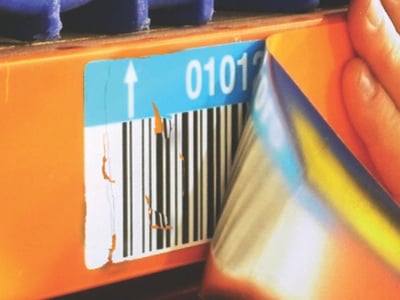
- Full Peel-and-Replace Floor Kits: Because robots require flawless floor navigation markers, old tape and damaged floor signs must be fully removed and replaced with high-durability, low-profile Floor Shield kits that can withstand heavy pivoting tires.
- Turnkey Tote Label Programs: When launching an automated fleet, matching a massive new inventory of plastic totes with sequential, perfectly placed barcodes is critical.
For larger facility retrofits and complex multi-site automation rollouts, managing data sequences and precise label application can strain internal maintenance teams. That's why ID Label offers an in-house installation services team. Our crews handle the entire process from data validation and clean removal to exact label placement, ensuring your physical infrastructure is completely optimized for your new robotic fleet from the very first cycle.
How ID Label Supports Robotic Warehouse Operations
A successful warehouse automation deployment requires a cohesive physical environment where robots can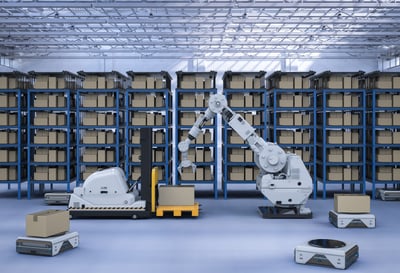 navigate and identify inventory without friction. ID Label provides a comprehensive, single-source suite of solutions designed specifically for these high-tolerance environments, including custom tote labels, precision rack labels, rugged floor labels, and turnkey nationwide label installation services. Every product we manufacture is engineered to meet the exact scan accuracy and durability standards that automated mobile fleets demand.
To eliminate the risk of systemic down-time, ID Label backs its automation products with a rigorous 20-step quality control process and a 100% scanning accuracy guarantee. We ensure your physical infrastructure reads flawlessly on every single pass, so your technology investment can deliver the peak throughput it was built to achieve.
Ready to upgrade your warehouse infrastructure? See how ID Label can help your operation successfully implement robotics.
Frequently Asked Questions
What labels do warehouse robots use?
Warehouse robots primarily rely on a two-part labeling system: April tags (high-contrast fiducial markers) affixed to racks and floors for spatial navigation, and high-durability barcode labels placed on totes, pallets, and rack faces for inventory identification and tracking.
What is an April tag?
An April tag is a visual fiducial marker that looks like a simplified, blocky QR code. In automated warehouses, these tags act as physical coordinate markers; when a robot's camera scans an April tag, its software instantly calculates the machine's exact 3D position, distance, and angle relative to that rack or floor location for precise navigation.
How are tote barcodes different from pallet LPN labels?
The main difference comes down to lifespan and environment. Tote barcodes are permanent, ultra-durable tracking labels engineered to stay on reusable plastic containers for thousands of high-friction cycles through an automated loop. Pallet LPN (License Plate Number) labels are typically temporary, sequential tracking labels applied to inbound freight, pallets, or stretch wrap that leave the facility once an order is fulfilled.
Can existing warehouse labels be used with robotic picking systems?
Rarely. Legacy labels are designed for human operators using handheld RF scanners, which can easily adjust for crooked placement, minor scratches, or glare. Robotic vision systems require absolute geometric consistency, ultra-sharp print definition, and a matte, non-glare finish to prevent camera blindness and immediate system faults.
How do I know if my labels meet the scan accuracy requirements for robots?
If your current labels have a glossy finish that reflects overhead warehouse lighting, show signs of peeling or scratching, or vary in placement by even a quarter of an inch, they will likely cause robotic misreads. The best way to verify compatibility is to test machine-grade substrates directly against your automation vendor's camera specifications before a full fleet rollout.