

Warehouse floor marking, also known as warehouse floor striping, is the process of using epoxy paint or tape and floor safety signs to create visual cues for warehouse teams. These markings divide spaces, highlight hazards, outline workstations, and direct traffic to improve facility efficiency.
It is important to distinguish floor striping from other identification methods. While warehouse floor labeling solutions are used to identify specific rack and bulk storage locations, floor striping is primarily used for defining larger zones and traffic lanes. Facilities typically use two primary methods to achieve these visual cues: industrial paint or heavy-duty floor tape.
Why is warehouse floor striping essential?
Properly marked floors keep warehouse bulk storage items organized and ensure that space is used efficiently. Key benefits include: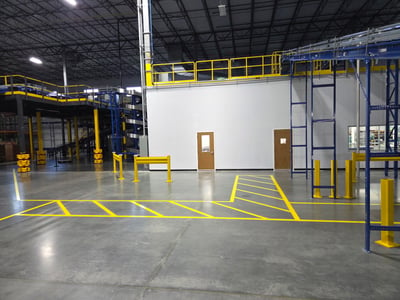
Warehouse Organization: Marking storage areas reduces wasted time by letting employees know exactly where equipment belongs.
Traffic Direction: Warehouse floor tape and warehouse floor paint are used to promote forklift safety by designating drive aisles, pedestrian pathways, and intersections.
Safety and PPE: Marking warehouse floors can alert employees when personal protection equipment is required, such as using a dotted red line to indicate where a hard hat is mandatory.
Lean and 5S Methodologies: Striped floors help keep operations lean and visually organized.
OSHA Floor Marking Color Standards
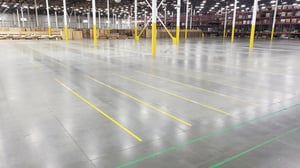 The Occupational Safety and Health Administration (OSHA) requires a visible, standardized system that is easy for employees to understand at a glance. Under OSHA 1910.176(a), permanent aisles and passageways must be appropriately marked. Furthermore, OSHA 1910.22(b) specifies that line widths should be between 2 to 6 inches, with 4 inches serving as the industry standard. Aisles must be at least 4 feet wide, or at least 3 feet wider than the largest equipment used in the facility.
OSHA 1910.144 establishes color requirements for physical hazards and fire safety. Industry practice has expanded this into a comprehensive 8-combination system. You can learn more about integrating these standards in our guide to promoting warehouse safety with signs and labels.
| Color / Combination | Designated Use |
|---|---|
| Yellow | Aisleways, traffic lanes, and work cells (most common) |
| White | Equipment storage zones, workstations, carts, and racks |
| Red | Fire protection equipment, emergency stops, and 5S red tag areas |
| Red and White | Safety/compliance clearance zones (electrical panels, eyewash stations) |
| Black and Yellow | Areas exposing employees to physical or health hazards |
| Orange | Inspection areas and energized equipment |
| Green | First aid stations and safety equipment locations |
| Black and White | Operational clearance zones (workflow related, not safety) |
While OSHA mandates specific colors for red and yellow in hazard contexts, consistency within your facility is more important than matching any external standard.
Warehouse Floor Marking Paint vs. Floor Marking Tape
Choosing between paint and tape is a critical decision for facility managers. As Brian Blair, ID Label's Installation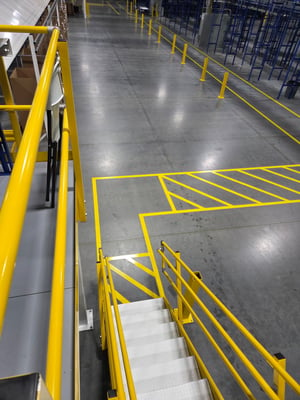 Manager, notes, "Without the floor markings, it's just a wide-open gray concrete floor. If you don't have lanes and set a pallet slightly off, the next row is slightly off and continues to drift until you've lost an entire pallet storage location".
For high-traffic environments, warehouse line painting is an effective option. Shot blasting is recommended before painting because it breaks through the concrete sealer, allowing the paint to adhere better and last longer.
Epoxy Paint: A durable option for permanent, high-traffic layouts. It requires a minimum 48-hour cure time but can take up to 7 days to fully set.
Acrylic Paint: A faster alternative that dries the same day, though it is generally less durable than epoxy.
Floor Marking Tape: Tape should be reserved for only two scenarios: pedestrian-only areas with small walkway aisles or leased facilities where the landlord prohibits painting.
A common misconception is that tape is easier to change later. However, vehicle tires create pressure seams that cause tape to tear in small strips when pulled up, making removal difficult. Conversely, shot-blast removal of paint is often more straightforward. For more information, read our Ask the Expert interview on paint vs. tape or explore our floor striping services.
5S Floor Marking
Integrating warehouse floor markings into your 5S program ensures a highly organized and productive environment. The striping applies to several 5S phases:
Sort: Use tape or paint to designate "red tag" areas for items currently under evaluation.
Set in Order: Striped storage zones and traffic lanes give every pallet and vehicle a designated location.
Standardize: Applying a consistent color-coding system across all zones ensures any worker can "read" the area immediately.
Sustain: Regular audits for repainting or retaping prevent the visual system from degrading over time.
How do warehouse signs maximize the effectiveness of floor marking?
Floor marking is often part of a larger visual communication system that includes overhead warehouse signs. These signs are highly recommended for identifying and managing bulk storage inventory. They typically contain a barcode image and human-readable numbers or letters and work in conjunction with long-range mobile scanning devices.
In addition to overhead warehouse signs, floor safety signs can also help communicate specific messages on warehouse floors with text and images to relay important safety or logistics information.
Warehouse Floor Marking and Striping Services
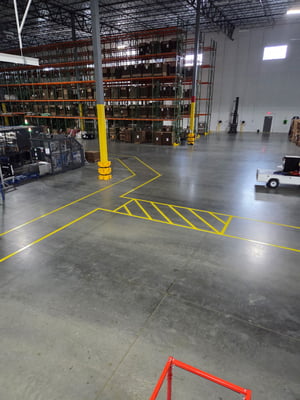 Large-scale or live-facility projects require phased planning and experienced crews to minimize operational impact. For example, a major 3PL recently reconfigured its space by removing more than 10,000 rack bays to create bulk staging areas. ID Label managed the project in four phases, allowing the facility to remain live while the team shot-blasted and striped the floors.
ID Label provides nationwide installation for professional warehouse floor marking and line striping. Our experienced crews specialize in high-performance solutions, including shot blast preparation and durable two-part epoxy warehouse line painting.
From initial CAD layout planning to the final application of industrial floor markings, we implement a consultative approach to help your operations make the most of our solutions.
Interested in learning more? Contact us today.
Frequently Asked Questions
What is the difference between floor marking and floor striping?
Floor marking is a broad term for using visual cues like paint, tape, and signs to organize a space. Floor striping specifically refers to the application of lines to define lanes and zones.
How long does warehouse floor striping last?
Shot-blast prepared lines typically last 3 to 5 years, while epoxy applied directly to a surface without preparation may last only about a year in high-traffic areas.
Can warehouse floors be striped without shutting down operations?
Yes. Professional installation teams can work in phases, often during off-hours or by cordoning off specific sections, to ensure your facility remains operational.
How do I remove old warehouse floor striping and markings?
For paint markings, a shot-blast machine is the most efficient and straightforward removal method. Tape removal can be more labor-intensive if the material has become brittle or torn.
What is the minimum aisle width for a warehouse?
OSHA recommends aisles be at least 3 feet wider than the largest equipment used, with a general minimum of 4 feet for pedestrian safety.
Does ID Label provide floor striping installation services?
Yes. ID Label offers nationwide, turnkey installation services, including shot-blast preparation, epoxy painting, and floor tape application.