

For organizations operating multi-site warehouses and distribution networks, consistency across facilities plays an important role in supporting safety, efficiency, and workforce mobility. Standardizing warehouse labels, signage, color systems, and symbology helps reduce training complexity while improving navigation and operational control across large facility networks.
John Roggeveen, senior business development manager at ID Label, explained that fragmented labeling systems often create unnecessary operational friction in multi-facility environments. He noted that when each site develops its own labeling approach, employees face a steeper learning curve when moving between locations. Differences in standard operating procedures (SOPs) can make transitions more difficult. As Roggeveen described, inconsistent labeling makes it harder for employees because “you’ve got all these different SOPs on how it works at different facilities.”
Network-wide standardization helps maintain operational alignment. When signage and labeling are consistent, organizations can more easily conduct safety audits, evaluate performance metrics, and compare productivity across sites without adjusting for local variation. This consistency is especially valuable in large distribution networks where visibility and reporting accuracy are critical.
Reducing Hidden Costs Through Centralized Labeling
One of the immediate advantages of standardization is improved cost management across procurement and operations.
“If everybody’s ordering individually, you can’t ensure the quality of product or guarantee the prices they’re paying,” Roggeveen said. “Standardizing label procurement through one defined supplier helps organizations maintain quality standards while potentially securing better pricing.”
Multi-site organizations also benefit from reduced administrative overhead when procurement is consolidated under standardized network specifications. Managing fewer vendor relationships simplifies ordering workflows and helps ensure materials are consistently produced to specification.
Improving Navigation, Safety, and Operational Accuracy
Consistent use of color, symbology, and structured label formats supports more efficient movement throughout warehouse environments.
Color coding is commonly used to identify storage zones, beam levels, or specialized operational areas such as hazardous material storage. Roggeveen explained that color systems help reduce operator training time because employees can visually confirm their location before scanning or performing work tasks.
These visual cues are particularly valuable in safety-sensitive environments where quick recognition of zone boundaries helps reinforce safe operational behavior.
Symbology standardization is equally important in large distribution facilities. Warehouses often contain multiple barcodes across packages, containers, or fixed assets. Standardized barcode structures help ensure scanning systems capture accurate data.
Roggeveen explained that a standard symbology approach “ensures that all labels are scannable from the required distances,” helping reduce workflow interruptions caused by misreads or scanning inconsistencies.
Supporting Workforce Mobility and Training Efficiency
Standardized signage contributes to workforce flexibility across multi-location operations.
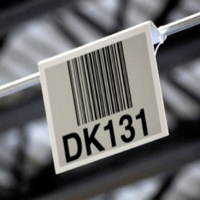 In networks with facilities across different regions, managers and management teams with multiple-site responsibilities can easily move between warehouses when using consistent labeling structures. Additionally, transfer or temporary workers can enter a new facility and understand navigation pathways without extensive retraining.
Maintaining standardized environments also helps organizations preserve operational knowledge as teams and leadership change over time. Clear design frameworks ensure new employees can operate effectively without relying on site-specific institutional knowledge.
Making Standardization a Sustainable Process
Successful network-wide standardization requires long-term organizational commitment.
If a facility needs to operate outside established standards, Roggeveen suggested using a structured review process to evaluate potential impacts.
“Maintaining consistency really needs to be an effort from the company to protect network integrity,” Roggeveen said.
Vendor alignment is also important. Working with partners who understand established network standards helps ensure materials, design, and installation practices remain consistent across locations.
Starting With a Network-Wide Labeling Strategy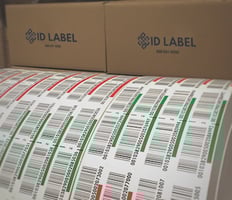
Organizations exploring standardization should also evaluate supporting infrastructure such as warehouse management software and location identifier formats.
Standardizing location codes, including character limits for identifiers such as pallet or LPN labels, can improve reporting accuracy and reduce manual data adjustments within warehouse management systems. Leveraging network purchasing volume can further support pricing efficiency while maintaining consistent material selection.
End-to-End Support for Facility Labeling Projects
Implementation expertise plays an important role in successful standardization initiatives. And there’s significant value that comes through working with experienced partners who can manage projects from concept through installation.
“At ID Label, we offer on-site consultation, designing of solutions, and we also install those solutions,” Roggeveen said. “We take your project from concept and follow it all the way through.”
The ID Label Advantage
Standardizing signs and labels across multi-facility operations helps create warehouse environments that are easier to navigate, safer for employees, and more efficient to manage. Through design guidance, centralized sourcing, and installation support, ID Label helps organizations build scalable labeling systems that maintain consistency across their entire operational network.
ID Label also offers pallet labels that work in conjunction with your warehouse management system to help you track products and materials from the moment they enter the warehouse until the time they leave.
Plus, ID Label’s industry-leading barcode labels, floor striping and signage are backed by our in-house team of experts who are eager to work with you at every step of the installation process. We implement a consultative approach to help your operations make the most of our solutions.