

A poorly labeled warehouse is a foundational flaw that can undermine a massive WMS integration investment and make a 5S methodology impossible to sustain over time. For facility managers, the physical infrastructure of warehouse labels is often the most overlooked component of a digital transformation, yet it is the primary interface between your staff and your WMS software. Without a clear, scannable, and durable labeling system, your new warehouse management system is only as accurate as the peeling, faded, or missing barcodes on your racks.
In this guide, we break down the role of warehouse labeling in supporting WMS integration and 5S methodology. From label types and materials to implementation planning and relabeling strategies, it provides a practical overview of how to build a system that improves accuracy, efficiency, and long-term performance.
"Your WMS won't work properly without the right barcode solution in place. Companies buy millions of dollars worth of systems, racking, software and equipment, but don't always understand the importance of the label itself to making everything work." — Scott Bender, ID Label
What Is a Warehouse Labeling System and Why Does It Matter?
A warehouse labeling system is a systematic approach to identifying every aisle, rack, bin, floor location, and inventory unit with scannable labels. It serves as the physical source of truth for your operations. By providing a physical anchor for your digital records, professional warehouse labeling directly enables:
- WMS Accuracy: Ensuring the WMS system knows exactly where every SKU is located to prevent “ghost” inventory.
- Picking Speed: Reducing the travel and search time workers spend looking for specific locations.
- Inventory Reconciliation: Streamlining cycle counts and annual audits through rapid scanning.
- 5S Method Compliance: Creating the visual discipline necessary for a lean environment by ensuring everything has a clearly marked home.
Proper labeling plays a foundational role in keeping areas organized to help eliminate the inefficiencies and organizational waste that the 5S methodology was established to counter. Adding warehouse labels to bins, racking and shelves is a cost-effective, easy solution to implement.
The Types of Warehouse Labels You Need for WMS Integration
Building an efficient facility requires selecting the right materials and designs for specific zones. For a deep dive into these options, see our guide on Common Types of Warehouse Labels.
Rack and Beam Location Labels
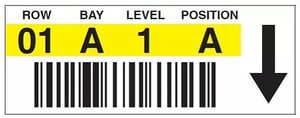 Rack and beam location labels are the most common warehouse rack labels, these are typically applied to horizontal beams. For standard environments, polyester or polypropylene materials are used, while retroreflective options are essential for long-range scanning from a forklift. Choosing the right pallet rack labels is a critical first step in professional rack labeling.
Vertical Location Labels (Totem Labels)
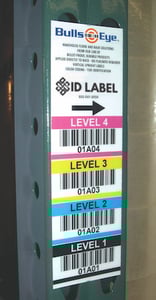
Ideal for multilevel racking, vertical location labels, or totem labels, consolidate all level barcodes at eye level on the rack upright. These are often color-coded by level to prevent picking errors. This FST Logistics case study is an example of how implementing color-coded beam labels improved picking accuracy. Vertical location labels offer a number of tangible advantages, especially when it comes to removing the need for eliminating long-range scanning, creating easier facilitation and minimizing error.
Warehouse Floor Labels
Warehouse floor labels mark bulk storage, pick zones, and staging areas where racks aren't present. Because they must withstand constant forklift traffic and pallet dragging, durability is the top priority. We recommend Floor Shield Labels and Covers to protect your investment. To avoid common errors, review 6 Reasons Warehouse Floor Labels Fail.
 Aisle Signs & Warehouse Signage
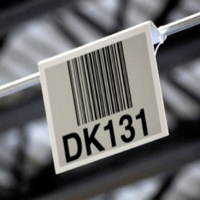
Effective warehouse signage, including overhead and aisle signs, provides the primary navigation for your facility. Using retroreflective and PVC options ensures visibility from a distance, directly supporting the “Set in Order” pillar of the 5S methodology.
Pallet & LPN Labels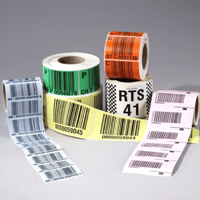
License Plate Number (LPN) labels track inventory from receiving through shipping. Scanning these warehouse barcode labels ensures that every inventory move is recorded in real-time within your WMS integration.
How Warehouse Labeling Supports 5S Success
A successful 5S warehouse relies on visual cues to maintain organizational discipline. And there are plenty of ways warehouse labels can enhance your 5S system program. For a deeper dive into each 5S pillar and how labels support them, see our guide on How Warehouse Labels Enhance Your 5S Program.
- Sort: Use Clean Release™ labels to easily identify and tag items for removal or relocation during the initial sorting phase.
- Set in Order: Clear 5S labeling ensures every tool, pallet, and SKU has a designated “home,” drastically reducing search time.
- Shine: Use Eco Beam Renew™ to give old, scarred racking a fresh, clean appearance without the labor of scraping old adhesive, helping maintain a clean workspace.
- Standardize: BullsEye™ labels provide a uniform look across the facility, ensuring workers know exactly where to look for information regardless of the zone.
- Sustain: To achieve 5S continuous improvement, conduct quarterly audits, replace damaged 5S labels, and retrain staff on labeling standards to prevent backsliding.
How to Prepare Your Warehouse Labels for a WMS Go-Live
Label readiness is the most commonly overlooked item on a warehouse management system implementation project plan.
To prepare for a WMS software integration, you must finalize your location naming convention, confirm barcode symbologies with your vendor, and conduct a full scan-accuracy audit of your physical labels at least several months before your scheduled go-live date.
WMS Implementation Checklist to Ensure a Smooth Transition
- Lock Naming Convention: Finalize your aisle/rack/bin numbering before any labels are printed. See our Tips for Effective Warehouse Numbering Schemes.
- Confirm Barcode Format: Ensure your WMS vendor supports your chosen barcode symbologies.
- Audit Existing Labels: Identify damaged or missing barcodes that could cause day-one system errors.
- Define Placement Standards: Ensure every label is applied consistently across all rack types for worker speed.
- Coordinate Timing: Align label printing and installation with your rack installation or WMS testing phases.
- Run a Scan Test: Perform a live scan accuracy test with your actual handheld devices before the system goes live
.
Relabeling an Existing Warehouse
WMS upgrades or warehouse racking labeling reconfigurations often trigger the need for relabeling. You can find.png?width=164&height=164&name=Beam%20Renew%20(1).png) more details in our post on 4 Proven Options for Relabeling Warehouse Racks. Key options include:
more details in our post on 4 Proven Options for Relabeling Warehouse Racks. Key options include:
- Eco Beam Renew™: A metallic-backed label that covers old barcodes perfectly.
- Magnetic Labels: Ideal for racking that requires frequent location changes.
- Clean Release™ Removable Labels: Great for temporary or seasonal pick zones.
- Full Peel-and-Replace: A complete refresh of the rack surface for long-term permanence.
How to Label a Warehouse That's Constantly Changing
.gif?width=300&height=100&name=Email%20Headers%20(5).gif) Labeling a dynamic warehouse requires flexible solutions like Eco Beam Renew™, magnetic labels, and Clean Release™ removable tags. These versatile labels allow you to reconfigure locations without damaging your racking or leaving behind adhesive residue. These are both tremendous options for warehouses that are constantly in flux.
Labeling a dynamic warehouse requires flexible solutions like Eco Beam Renew™, magnetic labels, and Clean Release™ removable tags. These versatile labels allow you to reconfigure locations without damaging your racking or leaving behind adhesive residue. These are both tremendous options for warehouses that are constantly in flux.
For 3PLs and fast-growth operations, the goal is to build a labeling system designed for change, not one that fights against it.
Can You Relabel Without Shutting Down Operations?
Yes. You can absolutely relabel your facility without a total shutdown. By using zone-by-zone relabeling or applying Eco Beam Renew™ over live racks. For larger projects, ID Label's nationwide installation team can perform swaps between shifts or during low-activity hours to ensure zero downtime. Our experts have overseen a wide variety of relabeling and installation projects and are equipped with the experience to navigate your facility through this important transition.
The Biggest Mistakes Companies Make When Setting Up Warehouse Labels
There are plenty of mistakes that can be made when setting up warehouse labels, which is why it's critical to have experts by your side to ensure a smooth installation. Here are the five most common mistakes to avoid:
- Naming Convention Finalized After Printing: Leads to data mismatches. Fix: Validate the scheme with your WMS vendor first.
- Wrong Label Material: Using indoor labels in cold storage or high-UV areas. Fix: Audit your environment before selecting materials.
- Manufacturer Brought in Too Late: Causes lead-time bottlenecks and installation rushes. Fix: Engage your label partner during early WMS planning.
- Inconsistent Placement: Confuses pickers and slows down operations. Fix: Create a facility-wide placement standard.
- No Pre-Go-Live Scan Audit: Discovering dead barcodes during launch. Fix: Test every label type with your actual hardware and software.
Ready for 100% Scanning Accuracy?
ID Label provides custom warehouse labels backed by a 20-step quality control process and a guarantee of 100% scanning accuracy. Whether you need a simple sample request to test our materials or a full quote request for a nationwide installation, we are here to ensure your WMS and 5S goals are met.
Request a Quote Request a Sample